
Partner sales accountability software keeps one shared record of who owes what next, across two companies. On a partner-led opportunity the work splits: your seller owes the internal approvals, your partner owes the customer workshop, the partner manager owes the deal registration. In a CRM that record lives only on your side, so a partner-side commitment is invisible until it is late. DealAlign holds the action against the opportunity with a single named owner, a due date, a status and, where it matters, the dependency that has to clear first — so overdue work and stalled dependencies surface while the deal can still be moved.
Who this is for, and what it solves
This matters to sales leaders, partner and alliance leaders, account executives and revenue operations in organisations that sell through distributors, resellers, systems integrators and other third parties — across software, hardware, medical equipment and other partner-led sectors. The common factor is not the industry; it is that half the work needed to close a deal happens inside another company.
Revenue operations feel this most sharply. When a partner-led deal slips, the post-mortem usually finds an action that nobody owned: a technical validation waiting on a partner resource, an approval sitting with your own legal team, a customer reference promised but never delivered. Each looked fine in isolation. Together they explain the slip.
How sales teams track partner commitments
Every action is held against the opportunity it belongs to, not in a separate task list. That structure is what makes a commitment trackable: you can read the deal and its outstanding commitments as one thing, rather than reconciling a pipeline report against a project board.
Each action records the following, and nothing is inferred:
- The action — what specifically has to happen next.
- The opportunity it belongs to, so the action has commercial context.
- Responsible party — whether the work sits with your team or the partner.
- Owner — one named person, not a team or a shared inbox.
- Due date and status, including overdue.
- Impact on the deal, and any dependency that must clear first.
A worked example you can follow
A fictional opportunity worth £180,000, sold with a reseller. Four actions are open. All figures and organisations are illustrative demonstration data.
| Action | Responsible party | Owner | Due | Depends on | Status |
|---|---|---|---|---|---|
| Confirm buyer signatory and budget holder | Partner | Meridian — A. Okafor | 12 Nov | — | Overdue |
| Complete technical validation workshop | Your team | DealAlign side — R. Patel | 15 Nov | Signatory confirmed | Blocked |
| Submit deal registration | Partner | Meridian — A. Okafor | 18 Nov | — | Open |
| Agree commercial terms with partner | Your team | DealAlign side — J. Whitfield | 20 Nov | Deal registration approved | Open |
Read as a sequence, this is why the deal was at risk. The technical workshop is blocked, not open, because it depends on a signatory the partner has not confirmed. The partner action is overdue by four days. Neither fact appears in a conventional pipeline status: the opportunity would simply show as progressing.
Finding overdue actions and stalled dependencies
Overdue and blocked are treated as different states, because the response differs. An overdue action needs a chase. A blocked action needs the dependency cleared first — and chasing the owner will not help.
In the example, the useful intervention is not to press the partner on the workshop. It is to escalate the unconfirmed signatory, because every downstream action is waiting on it. That distinction is the practical value of recording dependencies rather than just due dates.
Actions marked as partner-owned are separated from those owned by your own team, so the conversation can be taken to the right organisation with the right evidence.
Where a manager needs to intervene
A list of overdue actions across the whole partner portfolio is not itself a decision. What a manager needs is the small set of places where intervention changes the outcome. DealAlign surfaces actions against the deals they belong to, so attention goes to work that is blocking a live opportunity rather than to administrative slippage on deals already lost.
The practical uses are narrow and specific: which partner-side commitments are outstanding and ageing; which of your own internal actions are holding up a partner; and where the same partner is repeatedly the source of a stalled dependency. The last of these is a relationship conversation, not a deal conversation.
How this affects pipeline reviews and forecasting
A forecast review usually asks what the seller believes. Shared actions change the question to what can be evidenced: if the signatory is unconfirmed, the deal is not as far along as its stage suggests, whatever the confidence around it.
This connects directly to forecasting and deal risk. An open, overdue partner action is one of the clearest signs that a committed deal is resting on assumption — and it is a fact about the record rather than a judgement about the partner. See how evidence gaps show up as deal risk and why a committed partner deal can still slip.
What exists today, and what does not
The MVP is ready for a guided demonstration. What can be demonstrated now, using fictional demonstration data: actions held against a partner-led opportunity, each with a responsible party, one named owner, a due date, a status including overdue, an impact and a dependency relationship; partner-owned and internally-owned actions shown separately; and blocked actions distinguished from merely late ones.
What is not claimed. DealAlign does not currently claim a live two-way sync with a partner’s own systems, and it does not claim embedded Salesforce or HubSpot plugins — those are proposed, not built. Nothing on this page should be read as a claim about a partner portal, an automated notification engine or multi-tenant partner access, because those behaviours have not been confirmed as implemented and are not described here as available.
The precise permission model, how partner-side users would authenticate, and exactly which notification behaviour exists today are open questions listed for founder confirmation rather than guessed at. How data currently gets into the product, and what is planned, is set out on the product page.
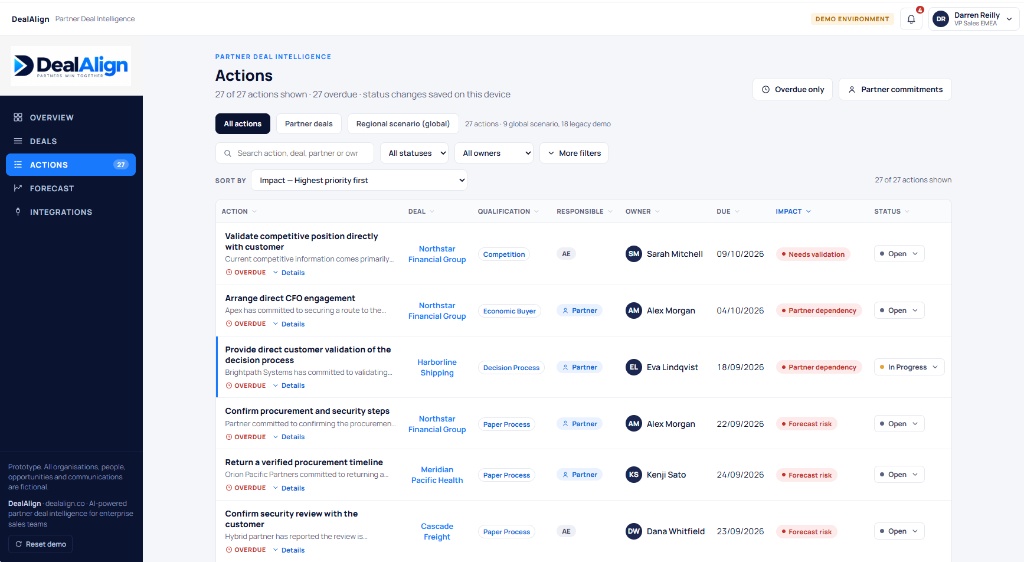
What this demonstrates, and what it does not. The example shows how accountability is modelled and why a blocked dependency differs from a late action. It is not evidence that DealAlign improves win rates, shortens sales cycles or recovers revenue. No customer result is claimed, and no improvement figure is offered.
Related guides
See how shared actions read on a real opportunity
A conversation is a working discussion, not a pitch. We can talk through where partner commitments currently live in your organisation, how overdue work is chased today, and what the MVP demonstrates.
See the shared-actions walkthrough Request a demonstration