
Partner Sales
How to Improve Collaboration Between Sales Teams and Partners
Most partner collaboration problems are not relationship problems. They are ownership problems — two organisations with different systems, different incentives and no shared record of what was agreed.
Improve collaboration between sales teams and partners by giving every deal one shared record, one named owner per step, and one next action with a date. In practice that means a joint deal plan both sides can see, owners named by person rather than by company, a weekly committed next step, and a single agreed definition of each pipeline stage. Teams that do this stop reconciling stories and start working the same list.
Collaboration between a vendor and a partner fails in a very specific way. Both teams are working, both are busy, and neither is wrong — but there is no artefact that says who is doing what next. The deal advances in two separate systems and then stalls somewhere between them.
Why partner collaboration breaks down
- Two systems, two truths. Your CRM records one stage; the partner's records another. Both are defensible and neither is shared.
- Incentives point in different directions. Your team is measured on your revenue this quarter. The partner is measured on their margin and their own portfolio.
- Ownership is assigned to companies, not people. "Partner to action" means nobody will.
- Communication is periodic, not continuous. A monthly review call is a reporting ritual, not a collaboration mechanism.
- Nobody wants to be the one who says it is stalling. Bad news travels slowly between organisations, and often not at all.
What good collaboration actually looks like
Four artefacts distinguish teams that collaborate well from teams that merely correspond.
| Artefact | What it contains | What it prevents |
|---|---|---|
| Shared deal plan | Buyer stakeholders, decision criteria, approval path, mutual next steps | Two teams pursuing two different theories of the deal |
| Named owner per step | A person and a company for each open action | "The partner is dealing with it" |
| Dated next action | One committed step, with a date, agreed by whoever owns it | Deals with activity but no movement |
| Agreed stage definitions | What evidence must exist before a stage can advance | Pipeline inflated on optimism |
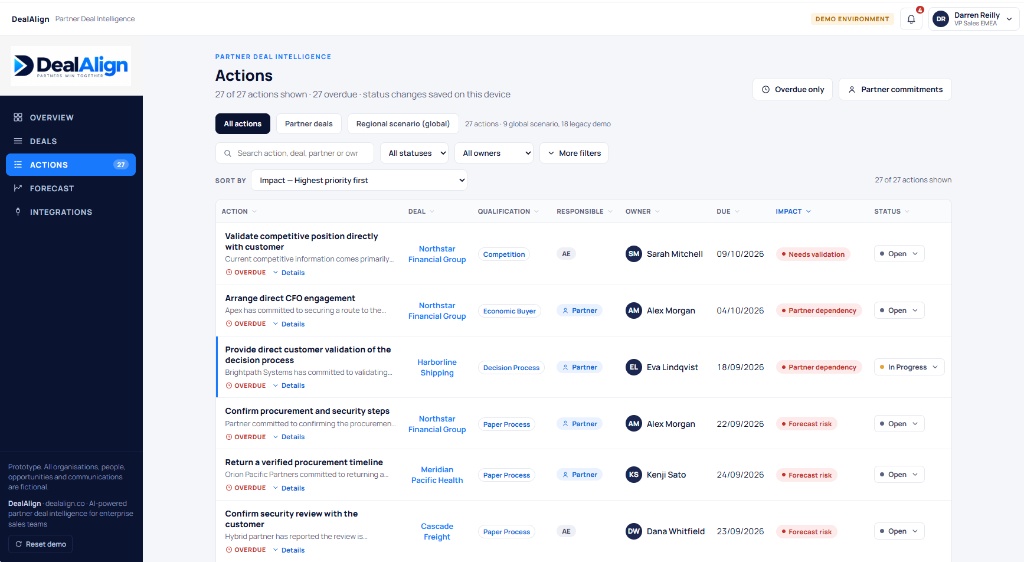
Real DealAlign screen: every action carries a responsible party, a named owner and a due date — which is the mechanism that makes "shared" concrete rather than aspirational. Illustrative data — fictional organisations and figures.
A practical weekly rhythm
Collaboration improves when it becomes a short, predictable routine rather than an occasional workshop.
- Before the call: both sides review the same deal list, ordered by deal risk and age of last buyer contact.
- During the call (30 minutes): for each material deal, confirm the last buyer-confirmed event, agree the single next step, and name one owner with a date.
- After the call: whoever owns the next step updates it in the shared record within the hour. No step is "agreed" until it is written down with a date.
- Next week: open by reviewing whether last week's committed steps happened. The ratio of kept to slipped commitments is the simplest collaboration metric there is.
Measure the collaboration, not the sentiment
Commitment reliability =
joint next steps completed by the agreed date
÷ joint next steps committed
Track this by direction: your team's reliability and the partner's reliability, separately. A gap between the two numbers usually explains the resentment on both sides better than any survey can, and it points at which conversation to have. Pair it with the core partner KPIs.
Fixing the three most common friction points
1. Deal registration disputes
Registration conflicts are rarely about the rules. They are about the rules being discoverable. Publish the criteria, apply them consistently, and make the decision visible to both sides within a defined window. Partners accept "no" far more readily than silence.
2. Presales and technical validation
Technical validation is the single most common place where a partner deal quietly waits. Assign a named technical owner on your side with an explicit service level, rather than routing requests into a shared queue that nobody monitors. See distributor performance for how this plays out differently when you are two steps removed from the end customer.
3. Forecasting arguments
Most "collaboration breakdowns" turn out to be forecast disagreements. If your team forecasts the deal at 70% and the partner forecasts it at 30%, you do not have a relationship problem — you have two different definitions of evidence. Agreeing what counts as forecastable resolves it permanently.
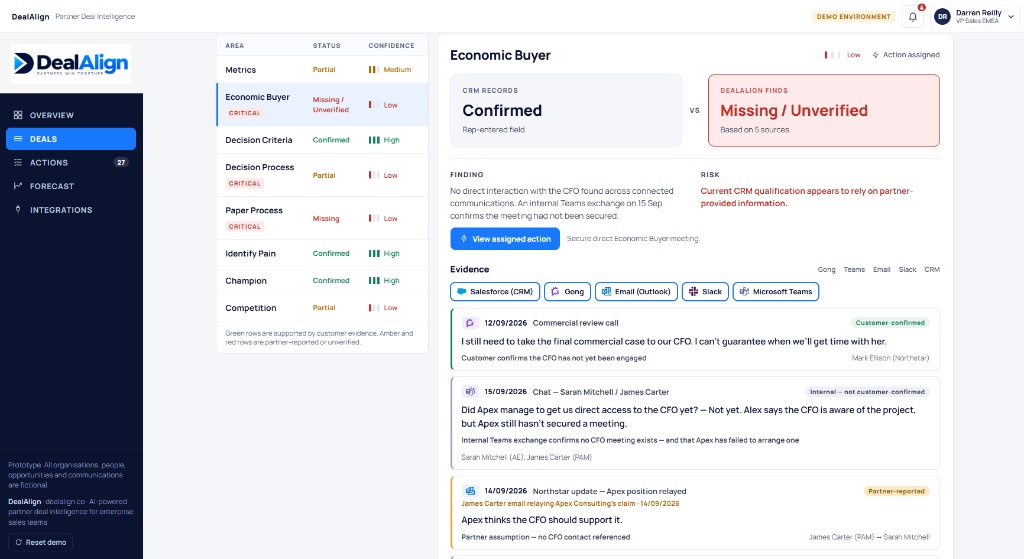
Real DealAlign screen: reported position shown next to buyer-confirmed evidence, so a disagreement about a deal becomes a conversation about facts rather than about credibility. Illustrative data — fictional organisations and figures.
What to change first
If you do only one thing this month, make the next action mandatory: every open partner deal must have exactly one next step, one named owner and one date. That single constraint exposes almost every collaboration problem you have, because deals without those three things are visible immediately.
If you do two things, add an agreed stage definition so that "in evaluation" means the same thing in both companies. Together these two changes remove most of the daily friction, and they cost nothing beyond the decision to enforce them.
Key takeaways
- Collaboration breaks on records, not relationships. Two systems produce two truths.
- Name people, not companies. "Partner to action" is an unassigned task.
- One next action with a date per open deal is the highest-leverage constraint.
- Measure commitment reliability in both directions, separately.
- Forecast disagreements look like collaboration failures — fix the evidence definition and the argument disappears.
Frequently asked questions
Should partners be given access to our CRM?
Usually not full CRM access — the permissions, data-protection and commercial exposure are hard to manage. What partners need is access to the deals they are involved in, the actions assigned to them, and the agreed stage definitions. A shared deal workspace achieves that without exposing your whole pipeline.
How often should joint pipeline reviews happen?
Weekly for material deals, monthly for the wider portfolio. Partner deals decay over roughly three weeks, so a monthly-only rhythm means you routinely learn about problems after the decision has effectively been made.
What if the partner refuses to share deal detail?
Start with the minimum: stage, close date, next action, owner. Many partners resist sharing because they fear disintermediation, not because the data is sensitive. Sharing your side of the plan openly, and being explicit that you will not contact the buyer without agreement, usually resolves it.
Does better collaboration actually increase revenue?
It increases the proportion of registered partner pipeline that converts, because fewer deals die of neglect. We would not put a percentage on that for your business — measure your own baseline before and after rather than adopting someone else's benchmark.
Give both teams the same record
Our MVP is ready. We can show you how a shared deal record, named owners and dated next actions look with your own partner scenarios.
How this guide was written
This is a practitioner guide, not a research paper. It is written from direct experience of running and advising channel partner programmes, and is intended as a structure for your own analysis rather than as evidence about your business.
- No external statistics. There are no survey results, benchmark figures or market-size claims in this article. Any number you see is either a worked illustration using clearly hypothetical figures, or a threshold we set ourselves and label as such.
- Heuristics are labelled. Where a score, weight or cut-off appears it is a founder-developed starting point, not a validated model. Calibrate it against your own data before relying on it.
- No customer results are claimed. Screenshots show illustrative data with fictional organisations. No named customer, deal or outcome is presented, and no performance improvement is implied.
- Borrowed frameworks are named. Where a guide uses an established method — for example the MEDDPICC qualification structure, or the standard management-accounting definitions of gross profit and contribution margin — it is named so you can consult the primary source rather than take our summary of it.
Related guides
Partner Sales
Identifying Partner Sales Deals at Risk
The warning signs that appear weeks before a loss.
Sales Forecasting
How to Improve Channel Sales Forecasting
Forecasting against evidence rather than confidence.
Reseller Performance
What KPIs Should You Track for Channel Partners?
The small set of measures that actually change behaviour.
Related reading
Product page
One owner, a due date, a status and a dependency for every next action across both companies.
Partner sales accountability →