
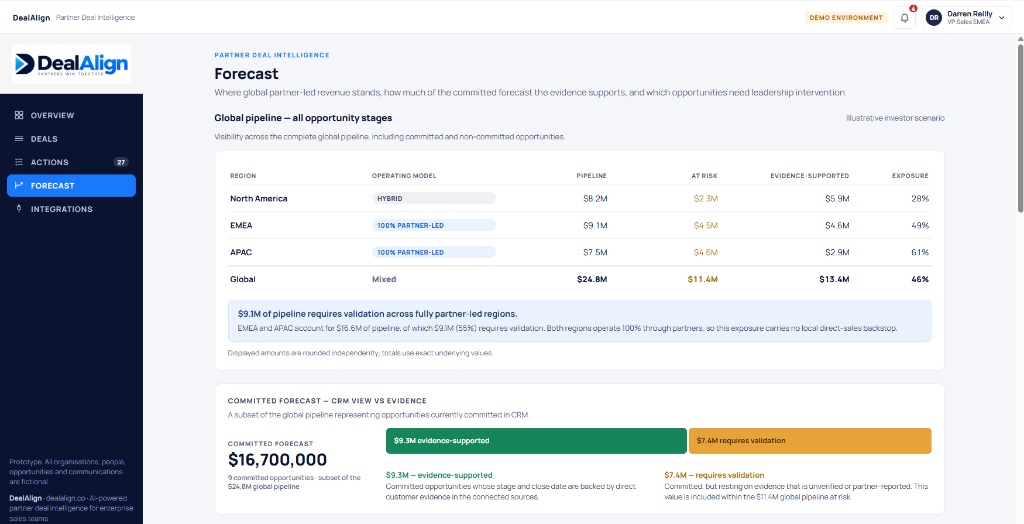
Why a partner deal can look committed without being real
In a direct deal, the seller usually owns every conversation. They meet the buyer, hear the objections, see the internal politics and can feel whether the deal is genuinely moving. In a partner-influenced deal, much of that signal sits with someone else — the partner — and reaches the seller second-hand.
That gap is where forecast risk lives. A deal can progress through stages, hold a credible value, carry a close date and still rest on assumptions nobody has tested. It looks committed because the CRM record is tidy and the partner is positive. It is not the same thing as being real.
Partner-led revenue is now a large share of enterprise pipeline, which makes this a mainstream forecasting problem rather than a niche one. The difficulty is not that partners are unreliable — it is that the evidence needed to judge a deal is scattered across different parties, each with a partial view.
Three versions of the same deal
A single opportunity often exists in three versions at once. They rarely agree, and the difference between them is the forecast risk.
| Source | What it usually tells you | What it often cannot tell you |
|---|---|---|
| Seller forecast | The seller’s own read of momentum, stage and close date — what they are willing to commit. | Whether the partner has actually validated budget, authority and the buyer’s decision process. |
| Partner update | Activity, relationship strength and what the partner believes is happening on the ground. | Whether the end customer has confirmed intent, funding or an internal decision path. |
| Buyer confirmation | Direct evidence of need, budget, authority, criteria and timing — the closest thing to truth. | It is the hardest to obtain, and is frequently assumed rather than secured. |
When these three versions diverge, the deal is not necessarily lost — but the forecast should reflect the uncertainty. A deal can be forecast as committed while the buyer version is unconfirmed and the partner version is optimistic. That is the slippage waiting to happen.
Reported confidence
£3.1M
Committed, as the CRM records it
- Stage and close date taken at face value
- Partner update read as buyer intent
- Budget assumed, not confirmed
Evidence-supported
£2.5M
Supported today · £600K still to validate
- Economic buyer confirmed directly
- Budget and criteria evidenced
- Paper process not yet recorded
How hidden risk becomes slippage
Slippage is rarely a single event. It is the visible end of a process that ran quietly for weeks, in which an unconfirmed assumption was carried forward unchanged until the point it could no longer hold.
Deal enters commit
Day 0
Partner reports it will sign this quarter.
No buyer contact
Week 3
Updates continue; nothing is confirmed directly.
Close date holds
Week 9
The date is treated as reliable because it has not moved.
Slip
Week 12
Budget and signatory still unconfirmed; the deal moves a quarter.
Warning signs of partner forecast risk
Most forecast misses in partner deals are not sudden. They are visible earlier as signals that are easy to explain away in the moment. Watch for:
- Stage progress without buyer contact. The deal advances while no one on your side has spoken directly to the economic buyer.
- A champion who is assumed, not tested. The partner is enthusiastic, but there is no evidence they can influence the customer’s decision.
- Verbal confidence, no artefacts. Positive updates arrive without documents, confirmations or next-step commitments behind them.
- Close dates that never move until they slip. The date holds for weeks, then jumps a quarter.
- Unconfirmed budget. The value is accepted as real, but funding has not been confirmed by the customer.
- Decision process described by the partner only. You are relying on a second-hand account of how the customer will actually decide and sign.
- Quiet periods. Contact goes quiet and is read as “no news is good news” rather than a risk signal.
A practical partner-deal forecast review checklist
This is a general review discipline, not a product feature. It works as a short conversation between the seller, the partner owner and the sales leader before the deal is committed.
- Economic buyer — has someone on our side had direct, two-way contact with the person who can release the budget? When, and what was said?
- Confirmed need — is the business problem stated by the customer, or only described by the partner?
- Funding — is the budget confirmed, identified or merely assumed? Is it capital or operating spend?
- Decision criteria — do we know what the customer will judge this on, and in what order?
- Decision process — who signs, who influences, what the steps are, and how long each realistically takes.
- Champion strength — who is advocating internally, and what evidence shows they have the influence we assume?
- Partner assumptions — which claims come from the partner alone, and how could we verify the most important one this week?
- Competition and alternatives — including the customer’s option to do nothing.
- Next action — is there one specific, owned, dated step that moves the deal forward, or only “follow up”?
- Evidence versus optimism — for the value being forecast, what is confirmed and what is still assumed?
A useful habit: for every partner deal in commit, write one sentence stating what would have to be true for the deal to close on time — then ask which part of that sentence is currently confirmed. The unconfirmed part is the forecast risk.
The seller
Brings the deal history, the momentum and the proposed close date.
The partner owner
Brings the relationship context and what the partner has actually committed to.
The sales leader
Brings the question that matters: what is confirmed, and what is still assumed?
The review is a short conversation between these three roles, held before the deal is committed rather than after it slips.
Running that review across a partner portfolio? If the confirmed-versus-assumed question is hard to answer at scale, a conversation may be useful. We can discuss where partner-led revenue is exposed in your forecast, and show you how the MVP reconciles the evidence behind each number using a synthetic dataset. Talk to us →
How DealAlign addresses this today
DealAlign is an AI-powered revenue and commercial optimisation platform for companies selling through third-party partners. It exists for exactly this problem: the evidence that decides whether a partner deal is real is spread across sellers, partners and buyers, and it is rarely reconciled in one place before the number is committed.
The product brings those signals together, shows where they agree and where they conflict, highlights the qualification gaps that matter, and makes the next action explicit — so the forecast reflects the evidence rather than the optimism. The MVP is available for guided demonstration using a synthetic dataset: regional pipeline visibility, per-deal risk and evidence windows, shared actions with owners and due dates, and partner profit contribution are all built and can be walked through.
What is not live yet is stated plainly on the product page integrations table. CRM imports and embedded Salesforce or HubSpot plugins are planned, not shipped, and the connection to an external AI assistant has not been built. Forecast inputs are entered directly or imported from a prepared dataset today.
Related
Managing partner-led deals in your forecast today?
DealAlign's MVP is ready for a guided demonstration. If partner-influenced pipeline is part of your number, a walkthrough is the quickest way to judge whether the forecasting view fits how your team reviews it.
See the evidence walkthrough Request a demonstration