
Sales Forecasting
How to Improve Channel Sales Forecasting
A channel forecast is not a prediction about your partners. It is a statement about how much of what they have told you is backed by evidence — and most channel forecasts never make that distinction.
Improve channel sales forecasting by forecasting from evidence rather than from partner confidence. Require every forecast deal to carry the date of the last buyer-confirmed interaction, a named next step with an owner, and a stated approval path. Separate committed pipeline from evidenced pipeline, apply a per-partner accuracy factor based on their own history, and review weekly at deal level. The forecast then stops being an aggregate of optimism and becomes a defensible statement about what has actually been confirmed.
Channel forecasting fails for a structural reason. In a direct model, the person forecasting is the person having the buyer conversations. In a partner model, they are not. Your forecast is built from someone else's reporting about conversations you did not attend, in a system you cannot see, using a definition of "commit" you did not set.
What a CRM does not capture
- Whether the buyer confirmed anything. A stage field reflects someone's judgement; it does not record what the buyer actually said.
- Who owns the next step. Without an owner, a next step is an intention.
- How many times the close date has moved. The field shows the current date, not the history.
- Whether the partner's forecast is inflated. Aggregates blend partners with different levels of reliability into a single misleading number.
- The gap between the two systems. Where you and the partner both record the deal, differences are usually reconciled by conversation rather than resolved by data.
Committed versus evidenced pipeline
This single distinction does more for channel forecast accuracy than any modelling technique.
| Evidence level | What exists | How to treat it |
|---|---|---|
| Asserted | The partner says it will close | Pipeline only, not forecast |
| Contacted | Buyer has met you or the partner; requirement discussed | Early-stage forecast at a low weighting |
| Validated | Buyer confirmed a requirement, a next step and a date | Forecast with a per-partner accuracy factor |
| Committed | Approval path known, decision date agreed, commercial terms discussed | Committed forecast |
| Contracted | Signature or purchase order received | Closed |
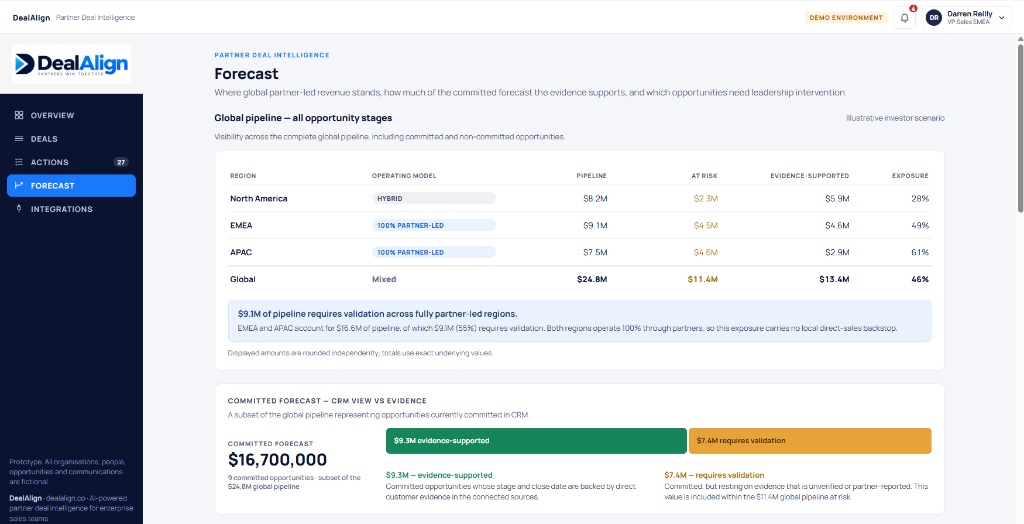
Real DealAlign screen: committed and evidenced pipeline held separately rather than blended, which is the single change that most improves channel forecast reliability. Illustrative data — fictional organisations and figures.
The evidence test, applied per deal
A deal is forecastable when all four are true:
1. A named buyer contact exists
2. That buyer confirmed a requirement in their own words
3. A next step is agreed, with an owner and a date
4. A close date is stated and has not moved more than once
Four conditions, all checkable in under a minute. Deals that fail one are pipeline, not forecast. This test is deliberately strict — a forecast that excludes uncertain deals is more useful than one that includes them at a discount nobody can justify.
Apply a per-partner accuracy factor
Not all partners report with the same reliability, and treating them as equivalent is the second most common cause of channel forecast error. Calculate each partner's historical accuracy and use it.
Partner accuracy factor =
revenue actually closed in period
÷ revenue that partner forecast for that period
Use a rolling four-quarter average, and apply the factor only to that partner's forecast. A partner whose factor is consistently 0.7 is not unreliable in a moral sense — they simply define commitment differently, and knowing that is what lets you forecast them accurately. Recalculate quarterly and watch the trend rather than the level.
| Partner | Forecast | 4-quarter factor | Adjusted |
|---|---|---|---|
| Northgate | $1,200,000 | 0.94 | $1,128,000 |
| Apex | $900,000 | 0.81 | $729,000 |
| Kestrel | $1,500,000 | 0.62 | $930,000 |
| Meridian | $400,000 | 1.05 | $420,000 |
| Total | $4,000,000 | — | $3,207,000 |
The unadjusted number is $4.0M; the adjusted number is $3.2M — a 20% reduction.
This is a conditional scenario, not a prediction. It shows what happens if each partner repeats its last four quarters' behaviour exactly. It is not evidence that a 20% miss will occur, and the factors above are illustrative rather than measured. The assumption is weak on purpose: four quarters is short, it averages over seasonality, and it cannot see a change in the partner's market. If you apply this adjustment and then report the original number, you will have produced a forecast you already know is overstated and will spend the last two weeks of the quarter explaining the gap. The adjusted figure is the defensible one because you can show the working — not because the history guarantees it.
Limitations to state whenever you present an adjustment like this: the measurement period (here, four quarters), the factor's construction (weighted or simple average of actual to forecast), the treatment of partners with fewer than four quarters of history (excluded, not imputed), and the fact that a factor persists only until it does not. Review the factors each quarter and publish them alongside the forecast so the basis is auditable.
A weekly forecast discipline
- Same day, every week. Forecast reviews that move around the calendar stop happening.
- Deal level, not totals. Start from the deals that changed since last week: new, advanced, slipped or lost.
- Ask one question per deal: what did the buyer confirm since we last spoke? If the answer is nothing, the deal did not advance.
- Reclassify immediately. A deal that fails the evidence test comes out of the forecast this week, not at quarter end.
- Record the reason. Over a quarter, the reasons form a pattern — and the pattern tells you what to fix in enablement or qualification.
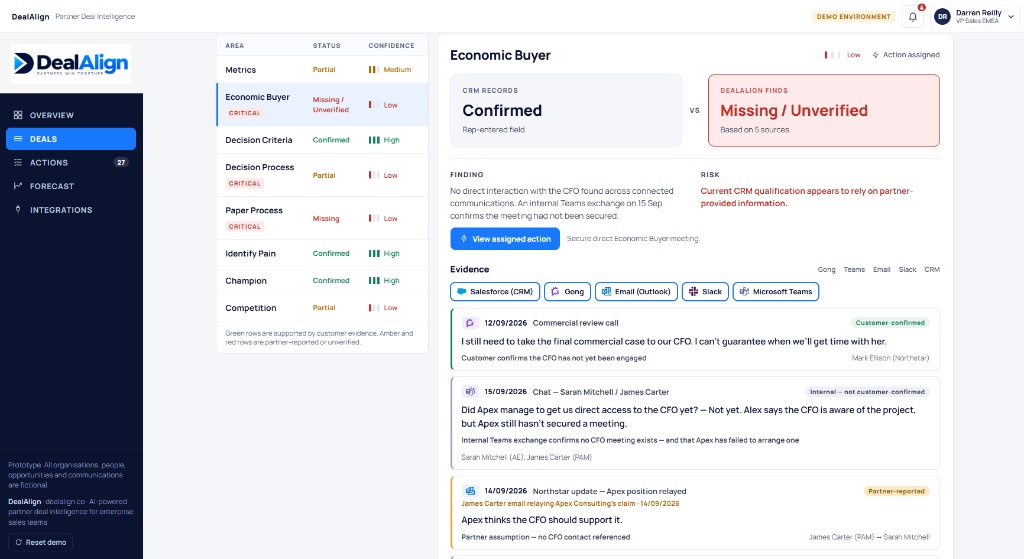
Real DealAlign screen: reported position against buyer-confirmed evidence, which is the comparison the weekly review is built on. Illustrative data — fictional organisations and figures.
Where AI genuinely helps — and where it does not
Forecasting tools are often sold as prediction engines. In a channel context the useful application is narrower and more valuable: reading the deal history and telling you what the evidence actually shows.
- Useful: summarising months of partner updates into what the buyer confirmed and when; flagging deals where the reported stage does not match the evidence; identifying close dates that have moved without explanation; spotting deals where the only contacts are internal.
- Not useful: predicting which deals will close. A model trained on your own deal history can estimate probabilities, but it cannot know that a partner has stopped returning the buyer's calls.
The honest framing: AI improves the quality of the evidence base. It does not replace the conversation that produces the evidence. Deals at risk are covered in more detail in identifying partner sales deals at risk.
What to fix first
If you change one thing this quarter, stop reporting a single blended forecast number. Report committed and evidenced pipeline separately, with the gap visible. That gap is the most honest statement you can make about forecast risk, and it usually takes less than a month to put in place.
If you change two things, add the per-partner accuracy factor. Together those two changes address the two structural causes of channel forecast error: uncertainty about what has been confirmed, and treating every partner as equally reliable.
Key takeaways
- Forecast from evidence, not confidence. Separate committed from evidenced pipeline.
- Four conditions make a deal forecastable: named buyer, confirmed requirement, owned dated next step, stable close date.
- Apply a per-partner accuracy factor from their own four-quarter history.
- Review weekly at deal level, asking what the buyer confirmed since last week.
- AI reads evidence well and predicts closures poorly. Use it for the first.
Frequently asked questions
Why is channel sales forecasting harder than direct forecasting?
Because the evidence sits with a third party. You do not run the buyer conversations, you do not control the system the deal is recorded in, and you often learn about change only when the partner chooses to report it. The forecast therefore depends on someone else's data quality and definition of commitment.
What is the difference between committed and evidenced pipeline?
Committed pipeline is what a partner or salesperson says will close in the period. Evidenced pipeline is the subset backed by buyer-confirmed facts — a dated meeting, an agreed evaluation step, a stated approval path. Forecasting from the second rather than the first is what makes a channel number defensible.
How often should a channel forecast be updated?
Weekly for material deals. Partner deals can decay over roughly three weeks, so a monthly cycle means you report a problem after the point at which it could have been fixed.
How do we forecast distributors who will not share deal detail?
Forecast sell-through rather than sell-in, and use the distributor's own historical seasonality with an accuracy factor. Where you have no deal detail at all, your forecast is a demand estimate, not a pipeline forecast — label it that way so nobody mistakes one for the other. See improving distributor sales performance.
Should we use a weighted pipeline model?
Weighting by stage is a reasonable starting point, but it assumes every deal at a stage is equally likely. Combine stage weighting with the evidence test and a per-partner factor, and the number becomes considerably more reliable. Stage weighting alone is how most channel forecasts end up wrong in the same direction every quarter.
Forecast partner revenue you can defend
Our MVP is ready. We can show you how committed and evidenced pipeline, deal risk and per-partner accuracy come together using your own scenarios.
How this guide was written
This is a practitioner guide, not a research paper. It is written from direct experience of running and advising channel partner programmes, and is intended as a structure for your own analysis rather than as evidence about your business.
- No external statistics. There are no survey results, benchmark figures or market-size claims in this article. Any number you see is either a worked illustration using clearly hypothetical figures, or a threshold we set ourselves and label as such.
- Heuristics are labelled. Where a score, weight or cut-off appears it is a founder-developed starting point, not a validated model. Calibrate it against your own data before relying on it.
- No customer results are claimed. Screenshots show illustrative data with fictional organisations. No named customer, deal or outcome is presented, and no performance improvement is implied.
- Borrowed frameworks are named. Where a guide uses an established method — for example the MEDDPICC qualification structure, or the standard management-accounting definitions of gross profit and contribution margin — it is named so you can consult the primary source rather than take our summary of it.
Related guides
Partner Sales
Identifying Partner Sales Deals at Risk
Warning signs that appear weeks before a loss.
Reseller Performance
What KPIs Should You Track for Channel Partners?
The small set of measures that actually change behaviour.
Partner Sales
Collaboration Between Sales Teams and Partners
Fixing ownership when a deal spans two companies.
Related reading
Product page
Partner-reported pipeline read against the evidence and shared actions behind it.
Partner sales forecasting software →