
Partner deal risk is the gap between what a partner reports and what a buyer has actually confirmed. Deal risk management software is only useful if it can show that gap per opportunity rather than per portfolio. DealAlign lists each partner deal with a deal score, a risk level and an evidence state — aligned, gaps or conflict — so a deal that holds a credible value and a plausible stage can still be identified as resting on assumption. The value is timing: the gap is visible while there is still time to close it, rather than at the point the quarter closes.
Who this is for, and why partner deals decay quietly
This matters to revenue leaders, sales leaders, partner managers and revenue operations in organisations selling through distributors, resellers, systems integrators and other third parties — in software, hardware, medical equipment and other partner-led sectors. The structural point is the same in each: part of the customer relationship sits inside another company whose priorities are not identical to yours.
Nothing about that is dishonest. A partner has its own forecast, its own incentive and no particular reason to volunteer that a deal has stalled. The signal decays gradually — a workshop slips, a signatory goes unconfirmed, an economic buyer is assumed rather than met — and each individual slippage looks survivable. The risk only becomes obvious in aggregate, by which point it is usually too late to change the outcome.
How to identify partner deals at risk
The signs worth tracking are specific and observable in the record. They are also structural rather than a matter of feel: each one is a question about whether the evidence exists.
- No direct contact with the buyer for three weeks or more — the partner is the only channel to the customer.
- A next step with no named owner — usually a partner-side action nobody has accepted.
- A close date that has moved more than once without new buyer information.
- A stage that advanced without new buyer-confirmed information — the field changed while the evidence did not.
- Evidence conflict — the CRM asserts something the underlying evidence contradicts.
Individually, none of these closes a deal. Together they describe whether a forecast line is supported. A practical review discipline for these signals is set out in how to identify partner sales deals at risk.
Partner confidence versus buyer-confirmed progress
This is the distinction the product is built around. Confidence is what people say. Confirmation is what can be pointed at. A deal can carry the first without ever having the second, and a forecast built on confidence alone fails quietly and late.
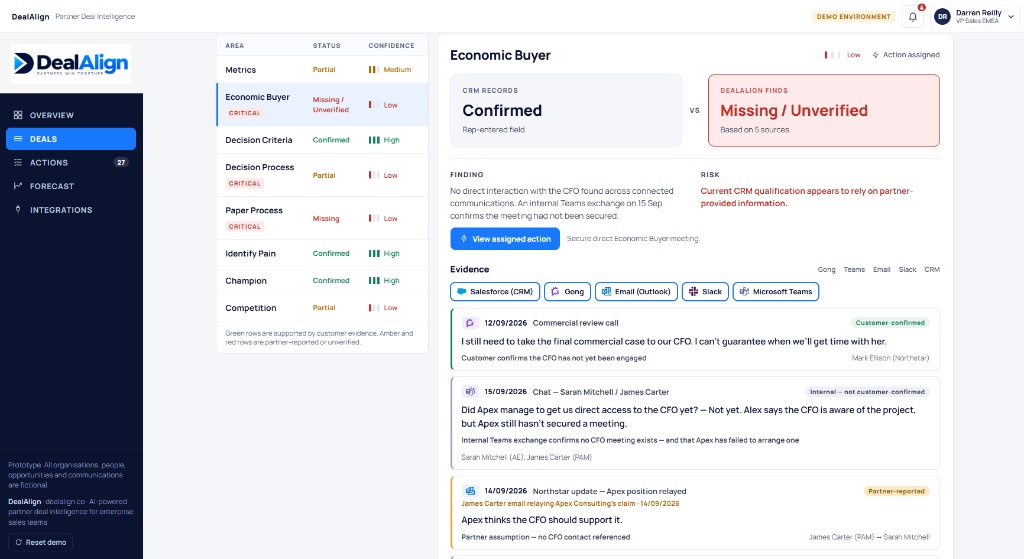
DealAlign holds three views of the same opportunity against each other: what the seller records, what the partner reports, and what the buyer has confirmed. Where all three agree, the deal is described as aligned. Where something is missing, it shows gaps. Where the sources disagree — the CRM says an economic buyer is confirmed and the evidence says it is missing or unverified — it shows conflict. Conflict is the state a forecast review most needs to see.
A worked example you can follow
Taken from the demonstration environment, where all organisations, people and opportunities are fictional. One opportunity from the deal list:
| Account | Northstar Financial Group — Digital Workplace Transformation |
|---|---|
| Partner | Apex Consulting |
| Deal value | $1,079,500 |
| Stage | Proposal / Commercial Validation |
| Deal score | 64 |
| Risk | Needs attention |
| Evidence | Conflict |
| Next action | Secure Economic Buyer meeting |
| Owner | Sarah Mitchell |
Why this deal is flagged rather than trusted. The stage says commercial validation and the value is over a million. But the evidence state is conflict, and the next action is to secure an economic buyer meeting — which tells you the economic buyer has not been met. A deal cannot be in commercial validation with the budget holder unconfirmed, and that is the contradiction the record is carrying.
Compare it with a healthy one from the same list: a $1,524,000 opportunity at negotiation, score 83, risk strong, evidence aligned, next action final pricing sign-off. Same pipeline, opposite position. Read as two rows, they tell a leader where to spend the week.
Intervening before the forecast becomes unreliable
The usable moment is when the gap is still closable. In the example above, the intervention is not to re-forecast the deal — it is to get the economic buyer meeting before the next review, because every downstream step depends on it. Where the gap cannot be closed in time, the honest choice is to move the deal out of the committed number rather than carry it.
That sequencing is what makes risk management commercial rather than administrative: it separates deals that need work from deals that need removing. The same principle applied across territories, where some regions have no direct coverage at all, is covered in partner pipeline visibility by region.
What sales teams and partners should do next
Each flagged deal carries a next action and one owner, which is what turns a risk list into work. In practice three responses cover most cases:
- Get buyer contact where the relationship has been mediated entirely by the partner.
- Reassign the action where it is sitting with a partner resource who has not accepted it.
- Reclassify the deal where the evidence cannot be obtained before the commitment is due.
Who owns each action, and how a blocked dependency differs from a late one, is covered in partner sales accountability.
What the MVP demonstrates, and what it does not
The MVP is ready for a guided demonstration. What can be demonstrated now, on fictional demonstration data: a deal list sorted by evidence risk, with deal value, stage, deal score, risk level, evidence state, next action and owner for each partner opportunity; evidence reconciliation showing the CRM record against what the sources actually support; and regional rollup of exposure and evidence-supported pipeline.
What is not claimed. The deal score and its risk bands are illustrative scoring shown in the product — they are not a validated predictive model, and no accuracy figure is offered because none has been independently established. DealAlign does not currently claim automatic alerts, background monitoring of a live CRM, or any guarantee that a flagged deal will slip. What it does is make the evidence state explicit at the point of review.
A separate, simpler weighted scoring worksheet appears in the guide on identifying deals at risk. That worksheet is a teaching aid for a manual review; it is not the same calculation as the deal score shown in the product, and the two should not be treated as interchangeable.
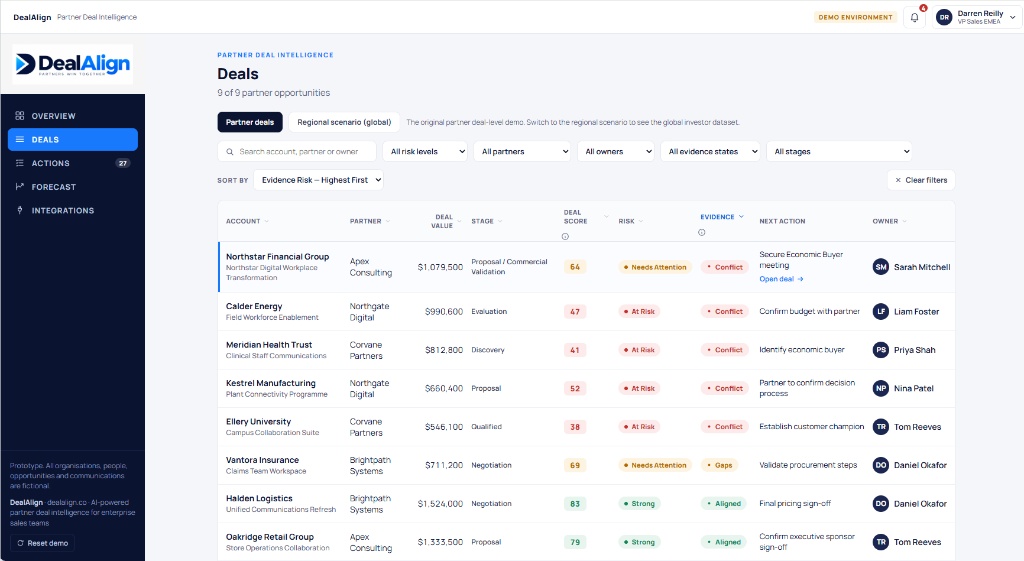
What this demonstrates, and what it does not. It demonstrates how evidence conflict, risk level and next action are presented per deal, and why that changes a review. It is not evidence that DealAlign predicts deal outcomes, recovers revenue or improves win rates. No predictive accuracy, customer result or ROI is claimed.
Related guides
See an at-risk partner deal reviewed in the product
A conversation is a working discussion, not a pitch. We can talk through how evidence is recorded against partner deals today, where your forecast relies on partner-reported confidence, and what the MVP demonstrates.
The deal-risk section of the MVP walkthrough shows the screens described here before you speak to anyone.
See the deal-risk walkthrough Request a demonstration