
Why a region needs its own view
A revenue leader carrying a regional number is answering two different questions at once. In territories with a direct sales team, the question is how well the team is executing. In territories that run through partners, the question is different: how much of what we are being told can be relied on?
Standard pipeline summaries can obscure differences in how directly each territory’s opportunities have been qualified. A region is summarised as a pipeline figure, a stage distribution and a forecast category. Nothing in that summary distinguishes a number a seller has personally qualified from a number that arrived as a partner’s update. That is where regional forecast risk concentrates — and where it stays hidden longest.
Direct, hybrid and partner-only territories
Most enterprise regions are a mix. The same leadership number spans territories where you have direct presence, territories where you work alongside partners, and territories where a partner is your route to market. Each type gives leadership a different quality of information.
| Territory type | What leadership can see today | Where the regional risk sits |
|---|---|---|
| Direct coverage | First-hand seller activity, direct buyer contact, own qualification of each deal. | Forecast discipline and deal execution — familiar, and visible in the CRM. |
| Hybrid | A mix: some deals directly qualified, others sourced and run with a partner. | Inconsistency. Two deals at the same stage can rest on very different evidence. |
| Partner-only | Whatever the partner reports, recorded in the CRM by a partner manager or channel lead. | Independent buyer evidence can be harder to obtain when reporting is mediated by a partner. |
The practical consequence: an unsupported territory can weaken confidence in the regional forecast, particularly where leadership depends heavily on partner reporting.
Reading regional exposure
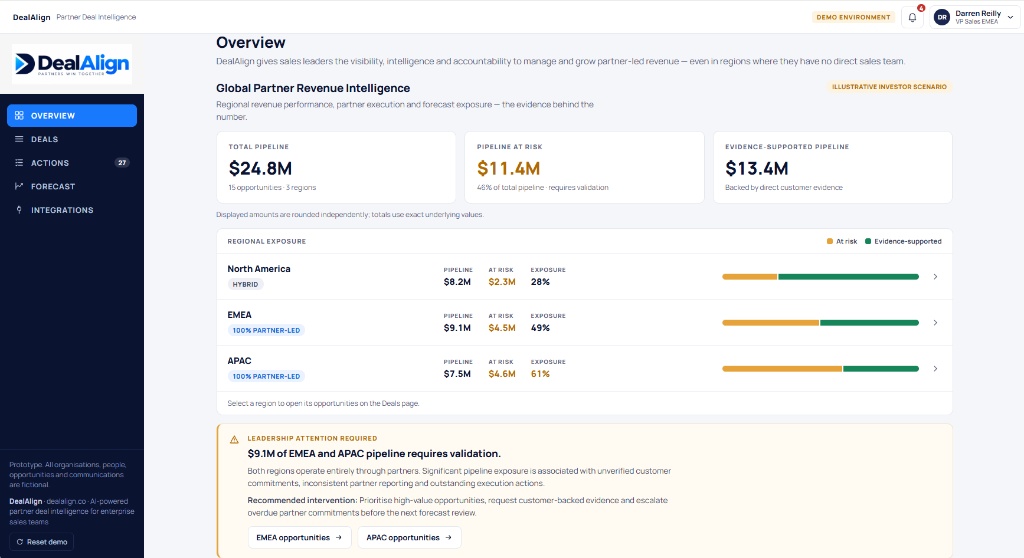
Regional exposure is the gap between the revenue a region is carrying and the revenue that is supported by evidence. Comparing regions on that basis — rather than on pipeline value alone — is what makes a cross-region comparison meaningful.
How regions are often compared
One dimension: pipeline value by region.
How it looks with evidence
Two dimensions: pipeline value and evidence support.
Where leadership intervention still changes the outcome
A regional view is only useful if it changes a decision. Three decisions it should support:
- Where to intervene first. The regions carrying the most value on the least evidence are the ones where management attention still has time to matter.
- Which commitments to chase. A region stalls when an open partner commitment sits unresolved and nobody can say who owns the next action.
- Whether to hire locally or keep growing through partners. If partner-led revenue is exposed rather than absent, the constraint may be execution rather than coverage.
These are the decisions the three outcomes are designed to inform: increasing partner sales, improving collaboration between the sales team and partners, and improving partner profitability — read from one evidence base rather than three separate reports.
Cross-company accountability in a regional operating model
Regional accountability breaks down at the boundary between companies. A partner commitment — a reference call, a technical validation, a commercial introduction — is often the single thing a regional deal is waiting on, and it sits outside the vendor’s direct control. Without a named owner, a due date and a status, the region has no way to see that it is waiting.
Partner reliability and forecast confidence
Forecast confidence in a partner-led region depends on how accurately that partner has reported before. Reading a confident update alongside a partner’s previous forecasting and delivery record is what turns a second-hand claim into a judgement leadership can defend.
DealAlign makes that context available at the point of the regional review. Partner performance history currently uses illustrative history only — DealAlign has not accumulated real customer history, and no validated predictive accuracy is claimed. Learning from a customer’s own historical partner performance is a planned capability.
How partner evidence fragments underneath the regional number
The regional figure is a summary of deal-level evidence that is produced by different parties at different times, and almost never lands in one view. Understanding the mechanics matters, because it explains why a regional number can be confident and unsupported at the same time.
| Evidence source | What it reveals | Where it misleads |
|---|---|---|
| CRM record | Stage, value, close date, contacts, activities — the canonical forecast view. | It records what was entered, not what was verified. Optimistic entries look identical to confirmed ones. |
| Seller activity | Who spoke to whom, what was agreed, where momentum feels real. | Reflects the seller’s interpretation; activity volume is not evidence of buyer intent. |
| Partner statements | Relationship context, access, competitive situation, local knowledge. | Second-hand by nature, and can be optimistic or out of date without anyone intending it. |
| Buyer evidence | Confirmed need, budget, authority, criteria and timing — the closest thing to truth. | Scarce, and frequently assumed rather than directly obtained. |
CRM record
“Stage 4. £850K. Closing 15 December.”
Records what was entered, not what was verified.
Seller activity
“Two workshops done. Momentum feels good.”
The seller’s interpretation of what activity means.
Buyer evidence
“Budget, signatory and timeline unconfirmed.”
The only source that can settle the question — and the scarcest.
The conflict becomes visible: two sources describe a deal that is moving, one shows no buyer confirmation at all.
What a clearer regional picture changes
- Earlier regional risk identification. Exposure is visible while there is still time to influence the outcome, rather than at the point the quarter closes.
- Better intervention decisions. Management attention goes to the regions and deals where it can still change the result.
- Clearer accountability. Every open partner commitment has an owner, a date and a status that crosses the company boundary.
- Greater forecast confidence. The regional number reflects what the evidence supports, not what the pipeline appeared to show.
None of these are guaranteed results, and DealAlign does not claim to produce them automatically. They are the outcomes the product is built to make more achievable.
Managing a region without a local sales team? If partner-led territories carry part of your number, a conversation may be useful. We can discuss how regional exposure and partner contribution are visible today. Talk to us →
How DealAlign helps today
DealAlign reconciles these fragmented signals in one place — holding the seller, partner and buyer views of a deal together, rolling them up by region, and showing where a regional number rests on claims rather than confirmation. From there it makes the next action explicit and owned. This is built and available to walk through today.
A regional number also carries a margin question, not only a pipeline one. Alongside regional exposure, DealAlign shows each region’s partner profit contribution once attributable costs are counted — so a region that is strong on revenue but weak on contribution is visible before it is discovered in the P&L.
Ready today, planned next. Regional visibility of partner pipeline and partner profit contribution by region are built. Partner performance history learned from your own past deals is a planned capability and is shown using illustrative history only; DealAlign has not accumulated real customer history and claims no validated predictive accuracy.
Related
Is a partner-led region part of your number?
DealAlign's MVP is available for a guided demonstration using a synthetic dataset. If managing partner-led regions is a live problem for your team, a walkthrough is the quickest way to judge whether the regional view fits how you work.
The MVP walkthrough shows the regional and deal-evidence screens described on this page before you speak to anyone.
See the regional and deal evidence Talk to us