
Reseller & Distributor
How to Improve Reseller Performance
Most reseller programmes can name their top three performers and their bottom three. What they usually cannot say is why the middle tier never moves — and that middle tier is where most of the recoverable revenue sits.
Resellers most often underperform for four reasons: they were recruited for reach rather than capability, they have no repeatable path from lead to close, nobody owns the next step on their live deals, and their enablement never converts into revenue. Improving performance starts by scoring each reseller on capability, not just on last quarter's revenue — then applying a different intervention to each tier instead of the same quarterly review to everyone.
A reseller is not a small version of your direct sales team. They carry several vendors, their salespeople are measured on their own quota, and your product competes for attention inside their business every day. Judging them purely on revenue tells you what happened, not what will happen — and by the time revenue drops, the relationship has usually been drifting for two or three quarters.
Why resellers fail to meet sales expectations
The causes repeat across industries, from software to medical equipment to industrial hardware:
- Recruited for coverage, not capability. A signature adds a logo to the partner portal. It does not add a seller who can run a technical evaluation.
- No qualification discipline. Reseller salespeople often qualify on relationship warmth rather than on a defined process, so forecasts carry deals that were never real.
- Enablement without application. Training completed is not capability acquired. Certification counts are an input metric.
- Attention diluted across vendors. Your product may be one of forty. Without a specific reason to lead with it on a given deal, the reseller will lead with whatever is easiest to sell.
- No shared next action. When a deal stalls, both companies assume the other is progressing it.
Which reseller KPIs actually matter
There are dozens of metrics you could track. These are the ones most often found to indicate future performance rather than describe past activity — a practical starting set to adapt, not a validated model.
| KPI | What it tells you | Warning threshold |
|---|---|---|
| Deal conversion rate | Whether registered deals actually close — the single best predictor of future revenue | Falling two quarters running |
| Pipeline coverage | Whether enough qualified pipeline exists to hit the next quarter | Below 3× target — a common starting point, not a universal constant |
| Deal velocity | Days from registration to close; long velocity signals friction in enablement or pricing | Rising while direct velocity is flat |
| Contribution margin | Whether the reseller is profitable once discounts, presales and support are counted | Below your channel average |
| Enablement application | Whether trained resellers sell — not whether they trained | Trained sellers with zero deals |
| Forecast accuracy | How often their committed deals land as stated | Repeated slippage on committed deals |
Notice that only one of these is a revenue figure. Revenue is the outcome; these are the mechanisms that produce it. A fuller KPI set is covered in what KPIs to track for channel partners.
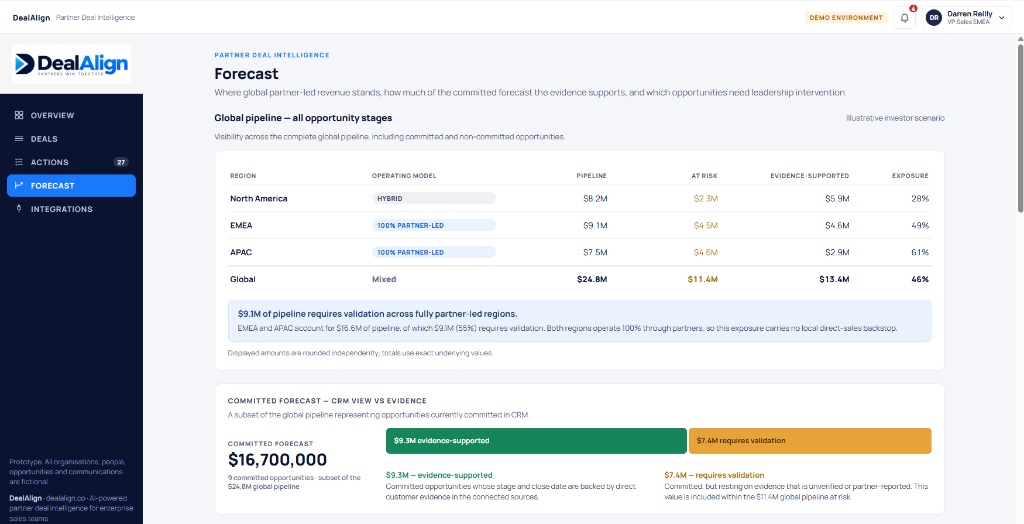
Real DealAlign screen: partner pipeline by region, splitting reported pipeline from evidence-supported pipeline. The gap between the two is where reseller forecasts usually break. Illustrative data — fictional organisations and figures.
How to identify underperforming resellers early
Early identification depends on watching behaviour between transactions, not after them. Four signals appear well before revenue falls:
- Registered deals stop appearing. A reseller who has stopped registering new opportunities has quietly de-prioritised you.
- Deals sit in the same stage for too long. Stage duration, not stage count, is the diagnostic.
- Their salespeople change. Reseller account managers turn over, and your product's internal champion goes with them unless you replace them.
- Support requests rise while revenue falls. This is the classic pattern of a reseller selling a product they cannot implement.
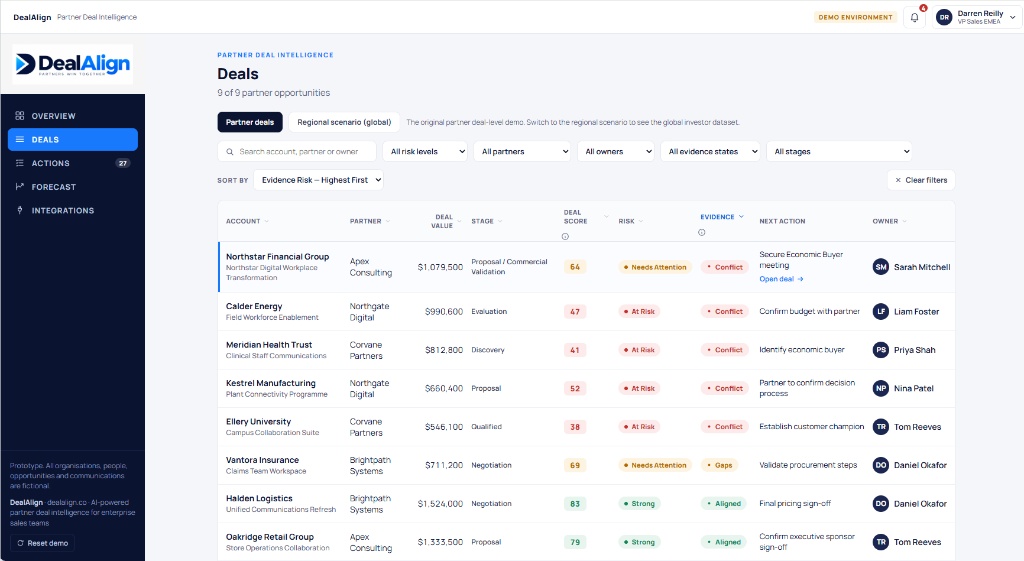
Real DealAlign screen: each partner opportunity carries a risk rating and next required action, so a reseller whose deals are all sitting at high risk is visible without waiting for a revenue miss. Illustrative data — fictional organisations and figures.
How to prioritise improvement actions
The mistake most programmes make is applying one intervention — another training session, another partner day — to every reseller. Different tiers need different treatment.
| Tier | Profile | Intervention |
|---|---|---|
| Invest | Strong conversion, healthy margin, rising pipeline | Joint business plan, named channel manager, co-marketing, early access to new products |
| Improve | Decent demand, poor conversion or thin margin | Deal-level coaching, qualification support, pricing clarity — a 90-day specific plan |
| Enable | Capable but not selling; training done, no deals | Joint first deal, paired with your own seller, pipeline-generation support |
| Reallocate | Repeated miss, low margin, high support cost | Reduce investment, move coverage to another reseller in the territory |
The distinction that matters commercially is between a reseller who cannot sell and one who will not prioritise you. Capability gaps respond to enablement. Prioritisation problems respond to commercial argument — a specific deal you can help them win this month, which is far more persuasive than a partner programme brochure.
When to reconsider reseller investment
Decide the criteria before the relationship is in trouble, so the decision is commercial rather than personal. A defensible test:
- Two consecutive quarters below the agreed plan, and
- conversion rate below the channel average, and
- contribution margin (a percentage) below your stated threshold for this tier — or, on the ratio basis, cost-to-serve above 1.0, meaning the partner-specific cost of serving them exceeds the gross profit they generate, and
- a documented improvement plan that has already run its course.
Compare like with like. Contribution margin is a percentage of revenue; cost to serve is a monetary amount. A margin percentage cannot be "below" a cost amount — that comparison is meaningless. Use one of two consistent tests: express both as percentages (contribution margin % against a stated margin threshold for the tier), or express both as money (cost to serve against partner-attributable gross profit, which is the ratio form below). Pick one, publish the threshold, and apply it identically to every reseller.
If all four hold, the revenue line is flattering a relationship that is costing you money. Deciding which partners to invest in sets out the full matrix, and why high-revenue partners can be unprofitable explains why size alone is a poor guide.
Key takeaways
- Score resellers on capability and conversion, not last quarter's revenue.
- Six KPIs are a useful starting set: conversion, pipeline coverage, velocity, contribution margin, enablement application and forecast accuracy.
- Early warning comes from behaviour between transactions — registration rate, stage duration and salesperson turnover.
- Different tiers need different interventions; one programme applied to everyone changes nothing.
- Set exit criteria in advance so reallocation is a commercial decision, not a personal one.
Frequently asked questions
What is a good conversion rate for a reseller?
There is no universal number, because it depends on what "registered" means in your programme. The useful measure is relative: compare each reseller's conversion against your channel average and against your own direct conversion. A reseller converting at half your direct rate is a diagnosis worth investigating, whatever the absolute figure.
Should we drop underperforming resellers?
Usually not immediately. First separate capability from prioritisation. A capable reseller who is not prioritising you can often be recovered with a specific deal you help them win. A reseller who cannot sell, and has had a documented plan and a fair period to improve, is a reallocation candidate — particularly if they cost more to serve than they return.
How many resellers should we have?
Fewer than most companies carry. Every reseller consumes recruitment, onboarding, enablement, presales support and partner management time. Beyond the point where you can support them properly, additional resellers add cost without adding revenue, which is the pattern described in reducing the cost of managing channel partners.
Does reseller performance differ from distributor performance?
Yes, in one important way: a distributor sits between you and the reseller, so you lose sight of end-customer demand. The metrics are similar but the visibility problem is worse. That is covered separately in improving distributor sales performance.
See reseller performance in one view
Our MVP is ready. We can show you how partner opportunities, risk and next actions appear across a reseller portfolio, using your own scenarios.
How this guide was written
This is a practitioner guide, not a research paper. It is written from direct experience of running and advising channel partner programmes, and is intended as a structure for your own analysis rather than as evidence about your business.
- No external statistics. There are no survey results, benchmark figures or market-size claims in this article. Any number you see is either a worked illustration using clearly hypothetical figures, or a threshold we set ourselves and label as such.
- Heuristics are labelled. Where a score, weight or cut-off appears it is a founder-developed starting point, not a validated model. Calibrate it against your own data before relying on it.
- No customer results are claimed. Screenshots show illustrative data with fictional organisations. No named customer, deal or outcome is presented, and no performance improvement is implied.
- Borrowed frameworks are named. Where a guide uses an established method — for example the MEDDPICC qualification structure, or the standard management-accounting definitions of gross profit and contribution margin — it is named so you can consult the primary source rather than take our summary of it.
Related guides
Reseller & Distributor
What KPIs Should You Track for Channel Partners?
A practical metric set, and the vanity metrics to drop.
Reseller & Distributor
How to Improve Distributor Sales Performance
Why distributors mask end-customer demand, and how to regain visibility.
Partner Profitability
How to Decide Which Channel Partners to Invest In
A decision matrix using revenue, growth and profit.
Related reading
Product page
Reseller performance read against evidence, contribution and margin rather than sell-in.
Channel partner profitability software →