
Partner Sales
How to Increase Sales Through Channel Partners
Most companies do not have a partner recruitment problem. They have a partner conversion problem: plenty of partners, plenty of registered deals, and a number that keeps arriving smaller than the pipeline suggested.
To increase sales through channel partners, work on the deals you already have rather than recruiting more partners. Partner revenue usually leaks in four places: deals with no confirmed buyer action, deals where the next step has no owner, deals forecast on the partner's word alone, and partners whose cost to serve exceeds the margin they generate. Fix the first three and conversion improves; fix the fourth and profit follows.
Partner programmes tend to be measured on inputs — partners recruited, deals registered, certifications completed, events run. Revenue responds to none of those things directly. It responds to whether individual deals progress. So the productive question is not "how do we get more partners selling?" but "which specific partner deals are stuck, and why?"
Why channel partner sales underperform
When you sell direct, one organisation owns the deal. The seller hears the customer, updates the CRM and controls the next step. When you sell through a partner, three parties hold different parts of the truth: your team, the partner, and the buyer. Nobody holds all of it.
That fragmentation produces a predictable set of failures:
- The partner reports optimism. A partner's forecast is a forecast of their own business, and they have little incentive to flag a deal as slipping until it has already slipped.
- Qualification is second-hand. Your team applies a qualification framework to answers the partner supplied, without independent evidence that the customer agreed.
- Next actions become nobody's job. A technical validation "in progress" between two companies, with no named owner and no date, is a deal decaying quietly.
- Nobody notices until the quarter closes. By the time the miss appears in reporting, the intervention window has usually shut.
None of these is a partner competence problem. They are information and ownership problems, which is why they respond to process rather than to partner incentives.
The four places partner revenue leaks
1. Deals with no confirmed buyer action
A deal where the only activity is internal meetings, partner calls and proposal revisions is not progressing — it is being discussed. The signal that matters is a dated commitment from the buyer's side: an evaluation scheduled, a business case submitted for approval, a security review booked. If the last three interactions were with the partner rather than the customer, treat the deal as unqualified until proven otherwise.
2. Deals where the next step has no owner
The most useful single field on a partner deal is not the stage or the value. It is the name of the person who owns the next action, which company they work for, and the date it is due. A deal with an unowned next step does not stall for commercial reasons; it stalls because nobody is doing anything.
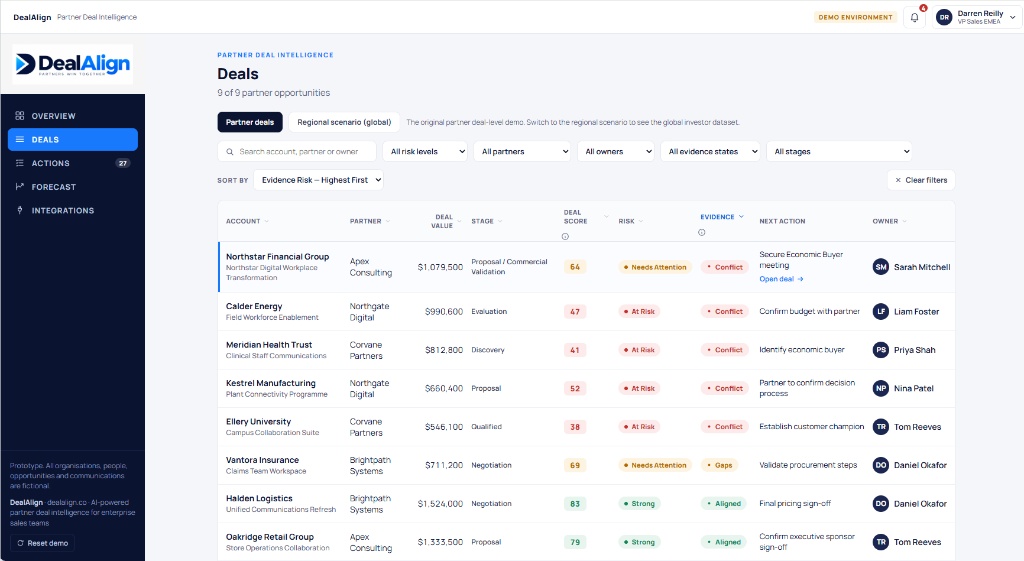
Real DealAlign screen: a partner portfolio where each opportunity carries a risk level, an evidence state and a specified next required action — so exposed deals are visible across the whole portfolio rather than discovered one partner call at a time. Illustrative data — fictional organisations and figures.
3. Deals forecast on the partner's word alone
If your committed number includes deals whose only supporting evidence is a partner email, your forecast is a measure of partner confidence, not of likely revenue. That is not a reason to distrust partners — it is a reason to separate "committed" from "evidenced" in your reporting so the difference is visible before close.
4. Partners whose cost to serve exceeds their margin
Revenue growth from a partner who consumes heavy presales, support and discount can reduce profit even as it increases sales. Growth in the wrong partner is a loss disguised as progress. This is covered in detail in why high-revenue partners can be unprofitable and how to calculate partner profitability.
How to spot the deals that need intervention
You do not need sophisticated analytics to start. Four questions, asked weekly of every partner deal above a material threshold, will surface most of the risk:
- What did the buyer agree to, and when did we last hear it from the buyer rather than the partner?
- Who owns the next action, and what is the date?
- What is the single largest thing that could still stop this deal?
- Is that thing being worked on right now, or merely acknowledged?
A deal that cannot answer all four is not a forecast item. It is a hope with a value attached.
| Signal | What it usually means | Action |
|---|---|---|
| No buyer contact in 21+ days | Champion has gone quiet or lost influence | Partner to secure a specific buyer meeting; if refused, downgrade the deal |
| Next action unowned | Nobody is actually working it | Assign one named owner and a date today |
| Stage advanced without new evidence | Stage change is administrative, not commercial | Re-test the exit criteria for the previous stage |
| Close date moved twice | Real decision driver is unidentified | Find the buyer's internal approval path or remove from forecast |
| Discount requested early | Value has not been established | Return to business case before pricing movement |
How to improve partner conversion rates
Conversion improves when the partner has a clear, small, dated next step and knows who owns it. That sounds trivial; in practice most partner programmes give partners a portal, a price book and a quarterly business review, and nothing that answers "what do I do this week on this deal?"
Three changes produce most of the gain:
- Make the next action explicit and shared. One owner, one date, one status — visible to both companies. This is the mechanism behind better collaboration between sales teams and partners.
- Give partners the qualification gaps, not the whole framework. A partner will not complete a 40-field MEDDPICC assessment. They will answer "who signs, and have you met them?"
- Review on evidence, not sentiment. Replace "how is this deal going?" with "what changed at the customer since last week?"
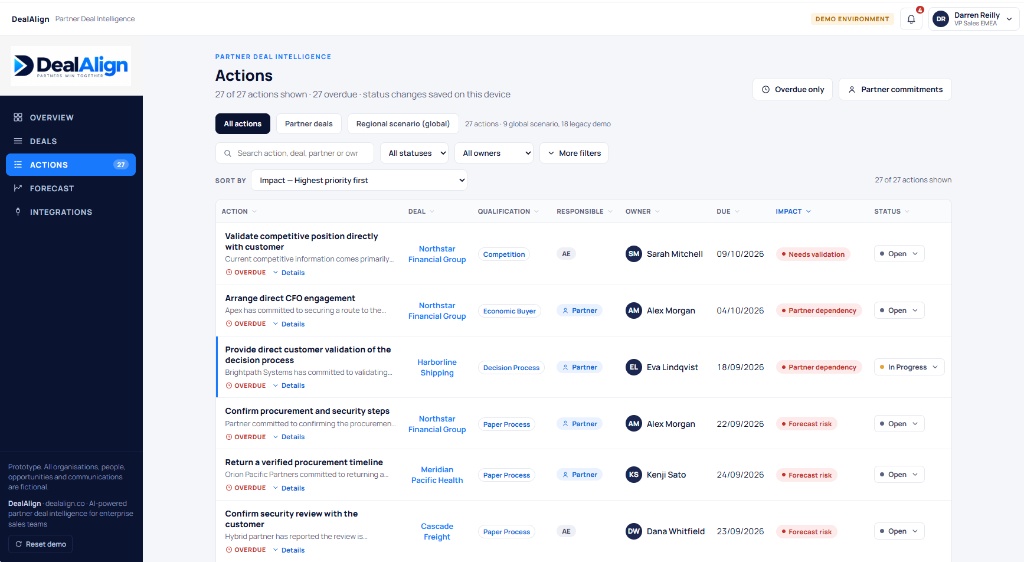
Real DealAlign screen: shared actions across your team and your partners, with the owning company visible on each line. Deals stall where this ownership is ambiguous. Illustrative data — fictional organisations and figures.
What AI can and cannot do here
AI is genuinely useful for three things in partner sales: summarising long deal histories so a review takes minutes rather than an hour; detecting patterns across a portfolio that no individual account manager would notice; and drafting the next action from what the evidence shows is missing.
It cannot verify that a buyer said something. It can only compare what was reported against what was recorded and flag the contradiction. Any tool claiming otherwise is asking you to trust a model over your own evidence — which is the original problem, automated.
A practical 30-day starting point
- Week 1: For your top 20 partner deals by value, record the last buyer-confirmed event and the owner of the next action. Expect to find several with neither.
- Week 2: Re-band those deals into "evidenced", "plausible" and "unqualified". Compare that split with your committed forecast.
- Week 3: Agree with your two largest partners a single shared action list, with owners and dates on both sides.
- Week 4: Change the forecast review question from "how confident are you?" to "what changed at the buyer?"
You will not need new software to start. But if the pattern holds, you will need somewhere that holds both companies' actions against the same deal — which is what DealAlign's partner sales view is built to do.
Key takeaways
- Partner revenue leaks at deal level, not programme level. Recruiting more partners does not fix conversion.
- The four leaks are absent buyer action, unowned next steps, unevidenced forecasting and unprofitable partners.
- Every material partner deal needs one owner and one date for the next action, visible to both companies.
- Separate "committed" from "evidenced" in forecast reporting so the gap is visible before close, not after.
- AI helps you find and frame the gap; it cannot substitute for buyer-confirmed evidence.
Frequently asked questions
What is the fastest way to increase partner sales?
Work the deals you already have. Identifying partner deals with no buyer-confirmed activity in the last three weeks, and assigning a named owner and date to each, usually produces faster movement than any recruitment or incentive change — because it addresses deals that are already in the pipeline rather than deals that do not yet exist.
Should we pay partners more commission to increase sales?
Only if the constraint is partner motivation. If deals are stalling because the next step is unowned or the buyer has gone quiet, a higher commission does not change either condition — it just makes the same stalled deal slightly more attractive. Diagnose the constraint before changing the incentive.
How do we get better forecasts from partners?
Ask a narrower question. "What is your confidence level?" invites a number. "What did the buyer agree to since we last spoke, and who confirmed it?" invites evidence. Record the answers and your forecast becomes testable. See improving channel sales forecasting.
Does this apply outside software companies?
Yes. The mechanism is indirect sales, not industry. Manufacturers selling through distributors, medical equipment companies selling through specialist resellers and hardware vendors selling through systems integrators face the same fragmentation: the party closest to the customer is not the party accountable for the number.
See this working on your own partner deals
Our MVP is ready. We can walk you through partner deal visibility and shared next actions using your own scenarios — no pitch, no financial claims.
How this guide was written
This is a practitioner guide, not a research paper. It is written from direct experience of running and advising channel partner programmes, and is intended as a structure for your own analysis rather than as evidence about your business.
- No external statistics. There are no survey results, benchmark figures or market-size claims in this article. Any number you see is either a worked illustration using clearly hypothetical figures, or a threshold we set ourselves and label as such.
- Heuristics are labelled. Where a score, weight or cut-off appears it is a founder-developed starting point, not a validated model. Calibrate it against your own data before relying on it.
- No customer results are claimed. Screenshots show illustrative data with fictional organisations. No named customer, deal or outcome is presented, and no performance improvement is implied.
- Borrowed frameworks are named. Where a guide uses an established method — for example the MEDDPICC qualification structure, or the standard management-accounting definitions of gross profit and contribution margin — it is named so you can consult the primary source rather than take our summary of it.
Related guides
Partner Sales
How to Identify Partner Sales Deals at Risk
The warning signs worth tracking, and when to act on them.
Partner Sales
Improving Collaboration Between Sales Teams and Partners
Why deals stall between two organisations, and how to fix ownership.
Reseller & Distributor
What KPIs Should You Track for Channel Partners?
The metrics that predict failure, and the vanity metrics to drop.
On this page
Product page
Where partner-led pipeline is exposed, and how a committed forecast can be defended.
Partner sales forecasting software →